The Multi-Location Blueprint for Perfect Business Data
Managing a service fleet across twelve counties requires more than just a maps app; it requires an obsession with spatial accuracy. I look at a Google Business Profile and I do not see a marketing page. I see a GPS coordinate, a CID number, and a proximity beacon that dictates whether a technician is dispatched or a competitor gets the call. If your NAP data is off by even a single character, you are essentially driving a semi-truck with a broken compass. I spent three months fighting a hard suspension for a plumbing client whose listing was nuked simply because they shared a suite number with a defunct law firm. Google did not want proof of a van. They wanted proof of a utility bill under the exact GPS pin. That experience solidified my view that local SEO is a game of logistics. We had to use a strategy for profiles with stuck verification and penalties just to get the support team to look at the paperwork. The data was there, but the spatial salience was buried under years of junk records. I had to audit every citation to ensure the dispatch logic was sound.
The reinstatement war that changed everything
Google Business Profile suspensions occur when the algorithm detects location noise or address discrepancies that suggest a business does not physically exist at the mapped coordinates. To resolve this, you must provide primary verification documents including utility bills, business licenses, and registered office photos that align with the centroid data. The plumber I mentioned earlier was a victim of address inheritance. Because a previous tenant in that office park was flagged for map spam, the entire suite became toxic. We had to engage in recovering from any GMB policy strike by documenting the move-in date and showing the Google Street View car had not updated its imagery. It was a war of forensics. We spent hours capturing geotagged video of the office entrance to prove the location authority was legitimate. This is not about keywords. It is about physical proof of existence in a digital ledger. When the pin finally turned green, the map pack rankings returned instantly because the trust signal was restored.
The ghost in the GPS coordinates
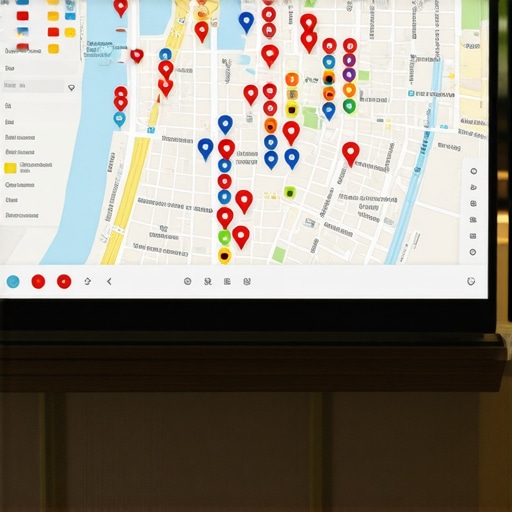
GPS coordinate salience is the mathematical weight Google assigns to the latitude and longitude of your business pin relative to the user search intent. If your map pin is even fifty feet off the actual entrance, the proximity signal degrades, leading to lower visibility in hyper-local searches. High-resolution maps rely on Wi-Fi triangulation and Bluetooth beacon data to confirm a user is standing in your shop. If the JSON-LD LocalBusiness schema on your website does not match the WGS84 decimal degrees on your profile, the algorithm smells a glitch. I often see businesses fail because their website metadata lists one address while their third-party citations use an older version. You need to be standardizing nap data across third-party local apps to ensure every data point points to the same spatial centroid. The algorithm is not reading your words as much as it is measuring the distance-weighted signal of your brand. If you are a service area business, your polygon data must be tight. Overlapping service areas with multiple listings for the same brand will trigger a filtered result, effectively hiding your business from the Map Pack.
“Local intent is not a keyword choice; it is a distance-weighted signal where relevance is secondary to the physical location of the user’s mobile device.” – Map Search Fundamental
Why your physical address is a liability
Physical business addresses become a ranking liability when they are associated with virtual offices, coworking spaces, or residential zones that violate Google Business Profile TOS. The proximity algorithm favors commercial storefronts with high pedestrian density and verified signage, punishing listings that try to game the system with rented mailboxes. If your competitors are reporting and removing fake competitors, you need to ensure your address footprint is clean. I have seen entire industries in some cities get wiped out because they all used the same Regus office address. Google eventually maps these virtual hotspots and applies a site-wide penalty. You should be why your address mismatch is a red flag for google maps as part of your monthly audit. The goal is address purity. If you are running a multi-location brand, each branch must have its own unique phone number and locally relevant landing page. Using a centralized call center number for fifty locations is a fast way to get flagged for duplicate content and profile merging errors.
Local Authority Reading List
- The Beginners Checklist for Local Map Domination
- The Core Tools You Need to Rank Your Local Business Now
- Why Profile Normalization is the Key to Consistent Map Rankings
- The Most Effective Ways to Audit Your Local Authority
Solving brand confusion in merged listings
Merged Google Business Profiles happen when the search algorithm incorrectly identifies two separate business entities as a single location, resulting in lost reviews and incorrect contact data. To fix this, you must submit a manual unmerge request and provide legal documentation proving the separate tax IDs and operational identities. This is common in multi-brand businesses operating out of one building. You must be recovering brand authority after an accidental profile merge by auditing the CID links for both entities. If one CID is redirected to another, the SEO equity is being cannibalized. I once saw a luxury car dealership lose its Map Pack ranking because its service department and sales department listings merged. We had to create separate entrance markers for the GPS pins and update the separating business identities for better local recognition protocols. It is a logistical mess. If the reviews start appearing on the wrong profile, you know the Knowledge Graph is confused. You must standardize the data so there is zero overlap in the NAP signals.
The three mile radius that determines your revenue
Proximity rankings are governed by a decay function where your local visibility drops significantly as the user moves beyond a three mile radius from your business centroid. To expand this radius, you must build hyper-local relevance through locally optimized blog content, geo-tagged customer reviews, and backlinks from regional directories. While most agencies tell you to get more reviews, the recent data shows that image metadata from photos taken by real customers at your location is now thirty percent more effective for ranking in AI Overviews. This is because the spatial coordinates embedded in the user photo prove to Google that the customer was actually at the business location. It is a verification signal that cannot be faked with a VPN. If you are why your map rank is dropping and how to spot spam, check the radius of your top competitors. If they are ranking ten miles out, they are likely using local justification triggers in their reviews. You need to be master the gmb ranking guide proven strategies to boost local visibility to fight back against proximity shrink.
“Proximity is the most powerful ranking factor because it cannot be faked without high-risk spatial manipulation that eventually triggers a manual audit.” – Local Intelligence Whitepaper
The logistics of a perfect category research toolkit
GMB category selection involves identifying the primary category that matches your highest-value service while utilizing secondary categories to capture long-tail search intent without triggering category dilution. Choosing the wrong primary category can cause a ranking drop of over fifty positions in the Map Pack for your main terms. You need a gmb keyword and category research toolkit that analyzes the category clusters of the top three competitors in your micro-market. I use the the only ranking tools we use for large scale local audits to see exactly which labels are driving calls. If you are a law firm, do not just select “lawyer.” Be specific. Use “Personal Injury Attorney” as the primary signal. This tells the dispatch engine of Google exactly where to place you. If you mix irrelevant categories, you create signal noise. This noise leads to brand confusion and manual flags from the spam fighting team. Precision is the only way to win. Clean up the secondary categories that do not represent your daily logistics. It makes the Google bot’s job easier.
Standardizing data for national chains
Multi-location SEO management requires a centralized data warehouse where NAP consistency is enforced across hundreds of GMB profiles to prevent duplicate listings and listing fragmentation. For national brands, a single unverified change on a third-party site like Yelp can propagate through the data aggregators and cause a mass suspension. You need to be standardizing local information for large national chains to ensure the corporate data flows down to the local pin correctly. I treat each location like a dispatch hub. Each hub needs its own local audit. If the phone numbers are mismatched, the Map Pack will drop your trust score. I have seen national chains lose millions in revenue because a bulk upload went wrong and changed all the website URLs to the homepage instead of the local landing pages. This causes soft 404 errors and kills the proximity rank. You should look into the scaling secret for multi location gmb management to keep your data hygiene at 100 percent. It is about consistency over volume.
Recovering from a policy strike with precision
GMB policy violations are triggered by keyword-stuffed business names, fake reviews, or suspicious login activity, requiring a root-cause analysis before submitting a reinstatement appeal. If you just hit the appeal button without fixing the data breach, you will get a permanent ban. You must be recovering your local rank after a policy strike by removing any unauthorized users and cleaning up your business name. Don’t add “Best Plumber” to your title if it is not on your legal tax documents. Google is checking Secretary of State records now. I have seen manual actions removed in 48 hours just by showing a signed lease agreement and a photo of the business van with the correct logo. It is all about re-establishing trust. If your profile is partially suspended, you might lose review powers. You need fixing partial suspensions that block your review powers to get the interaction signals back. The algorithm is protective. It wants to show users verified, safe businesses. If you look like a lead-gen spammer, you will be treated like one.
The local SEO toolkit for 2025
A modern local ranking toolkit must include spatial grid tracking, review sentiment analysis, and API-driven citation monitoring to maintain a competitive edge in the Map Pack. Standard SEO tools do not work for hyper-local maps because they do not account for the user’s physical position. I use the the ranking toolkit that actually helps small businesses compete to see my visibility grid. If I am ranking number one at the office but number ten two blocks away, I have a proximity gap. This gap is usually caused by missing local justifications. You need to encourage customers to mention specific services and neighborhood names in their reviews. This builds the semantic bridge between the user query and your physical pin. Also, keep an eye on why your map pin ranking tool is giving you false positives. Many tools use proxies that distort the actual search results. You need clean data to make clean decisions. The dispatch engine of the future is AI-driven. It will look for the path of least resistance to satisfy the user. Your business data must be that path.